
The EU's new €2 parcel fee: what it means for webshops selling into Europe
Since 1 November 2026, new EU customs charges have increased the cost of many e-commerce shipments sent directly to EU consumers from outside the EU. A €2 handling fee now applies per customs declaration line, alongside the temporary €3 customs duty introduced in July for qualifying low-value shipments.
For the marketplaces and webshops that send millions of small parcels into Europe each year, that changes the maths. For brands that keep their stock inside the EU, it is an opportunity. Here is what changed, what it costs, and what it means for your webshop.
Two new charges in four months
The EU has removed the old rule that let low-value parcels from outside the EU enter duty-free. The change came in two steps this year.
Both apply in all 27 member states, as part of the customs reform the Council of the EU approved on 3 September 2026. The €3 duty is a temporary measure scheduled to apply until 1 July 2028, when the EU Customs Data Hub is expected to become operational for e-commerce imports. Other parts of the customs reform will be introduced gradually.
A €100 order, €20 in extra charges
Both charges are calculated per customs declaration line, generally corresponding to a distinct product category. The €2 handling fee applies regardless of the shipment's value, while the temporary €3 customs duty applies to qualifying consignments worth up to €150.
The EU's own example: a €100 parcel containing four different product types.
That is 20% of the order value, and VAT comes on top. Platforms, sellers or shipping companies handle the customs procedure and pay the charges, and most will pass them on in product prices or delivery fees. Ordinary business-to-business shipments and gifts between private individuals are excluded.
4.6 billion parcels a year
The scale had become impossible to ignore. In 2024, about 4.6 billion e-commerce parcels worth under €150 entered the EU, and 91% of them came from China.
European retailers had argued for years that the duty-free threshold gave non-EU platforms an unfair advantage. Poland's Chamber of Digital Economy, for example, campaigned for its removal and estimates that the gap cost Polish retailers PLN 6.5–8.8 billion a year. The new charges are meant to put EU-based and non-EU sellers on a more equal footing, and to pay for the customs checks that billions of small parcels require.
Where your stock sits now matters
The impact depends on where your stock sits when a customer orders.
If you ship orders directly from outside the EU, qualifying low-value shipments are now subject to both the €3 customs duty and the €2 handling fee per customs declaration line. Orders containing several different product categories can be particularly affected. This means higher landed costs, tighter margins, and potentially higher prices for customers.
If you sell from inside the EU, your competitive position just improved. The price gap with far-away platforms has narrowed, especially in high-volume, low-margin categories such as fashion, electronics accessories and home goods. Fast delivery and easy returns now count for even more, because they are the advantages a parcel shipped from the other side of the world cannot match.
The cheaper route: ship from inside the EU
For businesses shipping regularly to European customers, EU-based fulfillment is becoming an increasingly attractive alternative to sending every order individually from outside the EU.
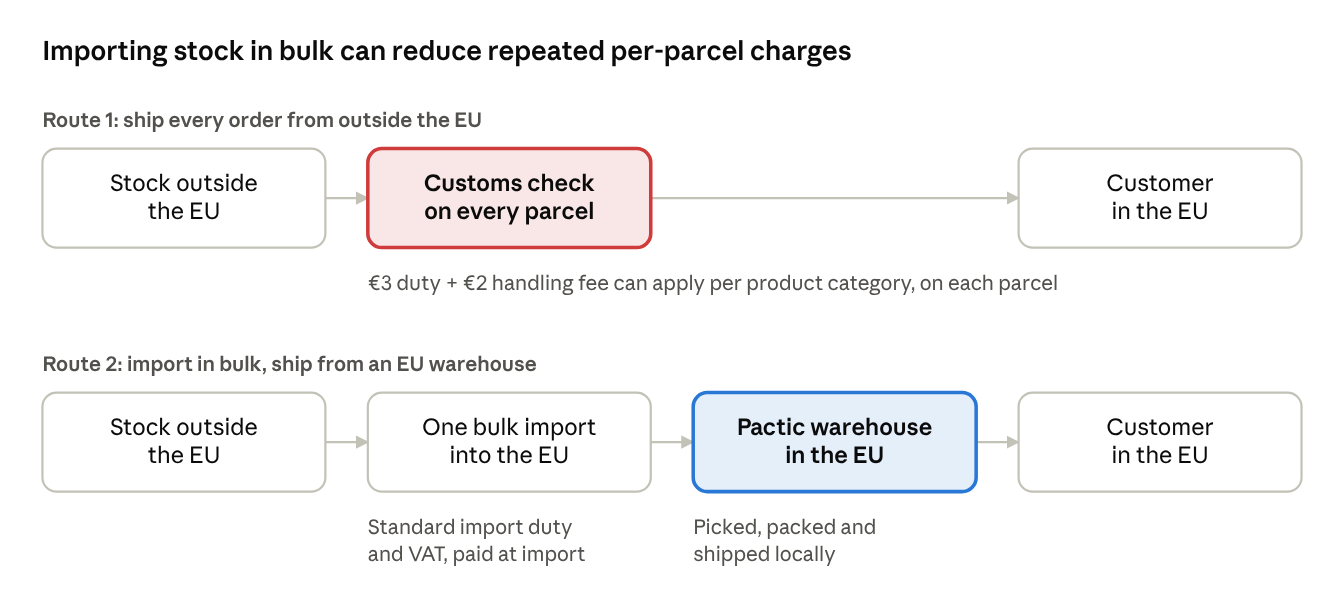
By importing stock into the EU in bulk, completing the necessary customs procedures, and fulfilling orders from goods already released for free circulation, webshops can avoid repeated import formalities and handling fees on individual customer orders.
This can also mean faster delivery, simpler returns, and a better customer experience.
Five things to check before your next shipment
A quick checklist for webshops selling into Europe:
Calculate your new landed cost. Review the customs classification of products in your typical orders. For qualifying shipments worth up to €150, calculate the €3 customs duty and €2 handling fee per declaration line, alongside applicable VAT.
Check your checkout. Make sure customers see the final price up front. Unexpected charges at delivery lead to refused parcels.
Compare the two routes. Weigh per-parcel fees against importing in bulk and storing stock in an EU warehouse.
Look at your fastest-selling products first. High-volume products are often the best candidates for EU-based fulfillment, as they can help spread storage and import costs across more orders.
Plan before peak season ends. Setting up EU fulfillment in January means you are ready for spring and the next peak.
Fulfillment from Hungary and Romania
Pactic stores, packs and ships orders for webshops from our warehouses in Hungary and Romania. Our warehouse system connects to the major e-commerce platforms and marketplaces, so orders flow in automatically. Our fulfillment team processed around 6 million items in 2025 with 99.99% inventory accuracy, and our cross-border network delivers to customers across Europe through one partner.
Romania is also a natural entry point for goods coming into Europe from the east, and a gateway to the Balkans.
Selling into Europe and want to see what EU-based fulfillment would cost you? Get in touch with our team.

